If you’ve been anywhere near the AI video space in 2026, you’ve probably noticed a major shift: we’ve moved past the era of “type a prompt, get a clip” and into the era of AI agents that handle entire video projects end-to-end. The difference is huge. Instead of generating one shot at a time and stitching things together in a separate editor, the new generation of tools takes your idea, plans the shots, generates the footage, adds music, and delivers a finished video — all in one go.
Two names that keep coming up in this conversation are Pollo Agent and Artlist AI. Both are positioned as all-in-one creative platforms, but they take very different approaches. I’ve spent the last few weeks running real projects through both, and in this guide I’ll break down where each one shines, where each one stumbles, and which is the better fit depending on what you’re actually trying to build.
The Shift from AI Tools to AI Agents
For most of 2024 and 2025, “AI video” meant fragmented workflows. You’d generate clips in one tool, do voiceover in another, grab music from a stock library, and assemble everything in CapCut or Premiere. Anyone who tried to ship daily content quickly hit a wall — not because the AI wasn’t good, but because the workflow was exhausting.
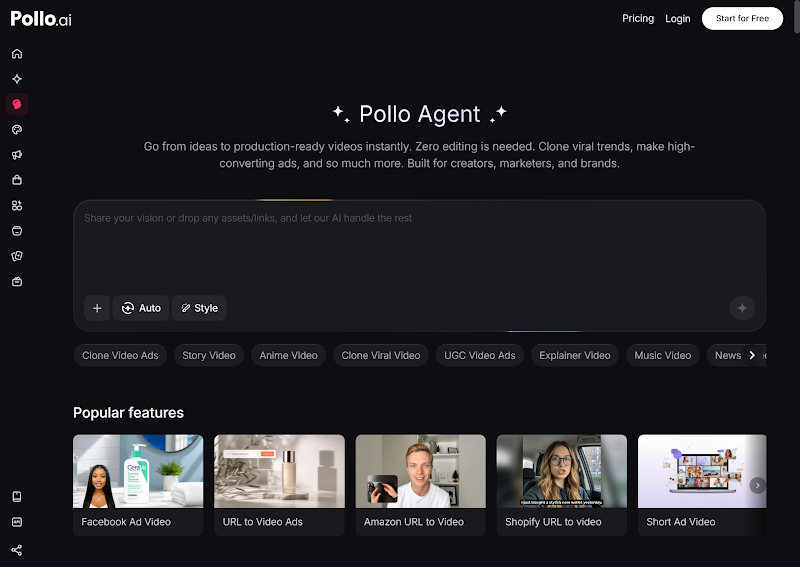
Agent-based platforms changed that. The premise is simple: you describe what you want, and the agent handles the production pipeline. The best example I’ve found this year is Pollo Agent, which sits inside Pollo AI’s Creative Studio and acts as a kind of AI director. You can feed it a product link, a rough script, a few images, or even just a topic, and it’ll return a fully edited video with scene transitions, captions, and audio. What makes Pollo AI’s approach different is that the agent isn’t locked to a single underlying model — it taps into the broader Pollo AI ecosystem, which aggregates the leading video and image models under one credit system. That means the agent picks the right tool for each shot instead of forcing every clip through the same engine.
Where Artlist AI Fits In

Artlist AI comes from a very different background. Artlist started as a premium stock music and footage marketplace, and over the past two years it’s expanded into AI generation. The result is a hybrid platform: you get access to professional stock assets, cinematic LUTs, and sound effects alongside AI-generated video.
This is genuinely useful for certain kinds of projects. If you’re producing a brand film, a polished product launch video, or anything that needs broadcast-grade music and color, Artlist’s library is a real advantage. The downside? Users in 2026 have consistently flagged two issues: latency (generations can take a while) and inconsistent output quality. When you’re trying to ship five videos a week for a TikTok campaign, those bottlenecks add up fast.
There’s also a philosophical difference. Artlist is built around the idea that AI should augment a traditional editing workflow. Pollo Agent is built around the idea that the AI should handle most of the workflow itself. Neither is wrong — but which one suits you depends entirely on how much time you want to spend in an editor.
Head-to-Head: What Each Tool Actually Does Well
Let me break this down by use case, because the “which is better” question really depends on what you’re making.
For ecommerce and DTC marketers, Pollo Agent has a clear edge. The ability to drop in a product URL and get back a 15–30 second ad-ready video — complete with hook, b-roll, and CTA — is exactly the workflow small marketing teams need. Pollo AI’s Marketing Studio is purpose-built for this, and the agent feels like an extension of that thinking.
For agencies producing high-end client work, Artlist AI is worth considering. The combination of licensed music, cinematic stock, and AI generation in one platform reduces the legal and licensing headaches that come with mixing assets from different sources.
For solo creators and content marketers who need volume, Pollo Agent wins on speed. The fact that it can produce music videos, news-style explainers, and story-driven clips out of the box means you spend less time setting up and more time publishing. Pollo AI also includes a built-in image generator, which becomes surprisingly useful when you need a custom thumbnail or a missing scene.
For educators and B2B content teams, both tools work, but Pollo Agent’s lower friction makes it easier for non-technical team members to actually use. I’ve watched marketing managers who’ve never opened Premiere produce a full explainer video in under 20 minutes using Pollo AI.
A Practical Workflow Using Pollo Agent
Here’s how I’d approach a typical week of content if I were running a small brand in 2026.
Start the week by feeding Pollo Agent your content calendar. For each topic, give it a one-line brief and any reference images or product shots you have. Let it generate first drafts of three to five videos at once while you focus on other work.
Review the drafts the same afternoon. The agent will get most of the structure right, but you’ll usually want to tweak the hook, adjust the pacing, or swap out a generic shot for something more on-brand. Pollo AI makes these edits easy because everything stays inside the same workspace — you’re not exporting to another tool and re-importing.
For higher-stakes pieces — a hero ad, a campaign launch, a brand film — that’s where you might layer in Artlist’s stock footage or licensed music as a finishing touch. The two tools aren’t necessarily competitors in every scenario; they can complement each other for certain projects.
Finally, batch your final exports and schedule everything. A workflow that used to require a freelancer, a stock subscription, and three different software tools now lives in one or two tabs.
The Honest Verdict
If I had to pick one platform for a small business or marketing team starting fresh in 2026, I’d go with Pollo AI. The agent-driven approach matches how content actually gets made now — fast, iterative, and multi-format. The shared credit system across Pollo AI’s Creative, Marketing, and Commerce studios means you’re not paying separately for every model or feature, which is increasingly rare in this space.
Artlist AI is still a strong choice for teams that already live in a traditional editing workflow and want premium assets baked in. But for sheer speed-to-finished-video, Pollo Agent is the tool I keep going back to.
Final Thoughts
The “best AI video tool” question is getting less useful every month. The real question in 2026 is which tool fits your production rhythm. If you’re shipping daily short-form, you want an agent that handles the busywork. If you’re producing a handful of polished pieces a month, you want a platform with premium assets and fine-grained control. Try both with a real project — not a demo — and let the output decide. That’s the only benchmark that actually matters.